What are some basic carpentery skills?
What Are Some Basic Carpentry Skills Every Homeowner Should Know — And When to Call a Handyman in Greenville, SC
Carpentry is one of those skills that touches almost every corner of your home. From a door that won't close properly to a shelf that needs fitting, from cabinet repairs to deck boards that have seen better days — wood is everywhere in a house, and knowing the basics of how to work with it can save you time, money, and frustration.
For homeowners across Greenville, Taylors, Greer, Travelers Rest, Simpsonville, Mauldin, Fountain Inn, and Spartanburg — this guide covers the fundamental carpentry skills worth understanding, the tools you'll need for basic tasks, and how our professional carpentry service handles the jobs that go beyond the DIY comfort zone.
Why Basic Carpentry Knowledge Matters for Homeowners
You don't need to be a master craftsman to benefit from understanding carpentry basics. Knowing how wood behaves, how joints work, and how to make accurate measurements means you can tackle small repairs confidently, communicate clearly with a professional when a bigger job comes up, and spot problems early before they become expensive. Even a basic grasp of carpentry fundamentals makes you a more informed homeowner.
The Basic Carpentry Skills Every Homeowner Should Know
1. Accurate Measuring and Marking
The oldest rule in carpentry exists for a very good reason: measure twice, cut once. Accurate measuring is the foundation of every carpentry task, no matter how simple. This means using a quality tape measure consistently, marking cut lines clearly with a pencil rather than a pen, using a carpenter's square to check that corners are truly 90 degrees, and understanding how to account for the thickness of a saw blade — known as the kerf — when marking your cut line.
Poor measuring is the single most common cause of carpentry mistakes at home. A shelf that's 5mm too long won't fit. A door frame cut just slightly out of square will never sit flush. Taking the time to measure carefully before cutting anything is the most important habit a beginner can develop.
2. Cutting Wood Safely and Accurately
Knowing how to make a clean, straight cut is fundamental. For most homeowners, this means becoming comfortable with a handsaw for smaller cuts and understanding when a circular saw or jigsaw is more appropriate for larger or shaped cuts. Key principles include always securing the workpiece firmly before cutting, cutting on the waste side of your marked line, letting the saw do the work rather than forcing it, and always wearing appropriate eye protection.
For cross-cuts — cutting across the grain — a miter box and handsaw combination is an affordable and reliable option for beginners tackling trim work, skirting boards, or shelf brackets. For rip cuts along the grain of longer boards, a circular saw with a straight edge guide gives much more control and accuracy than a handsaw.
3. Using a Drill and Understanding Fixings
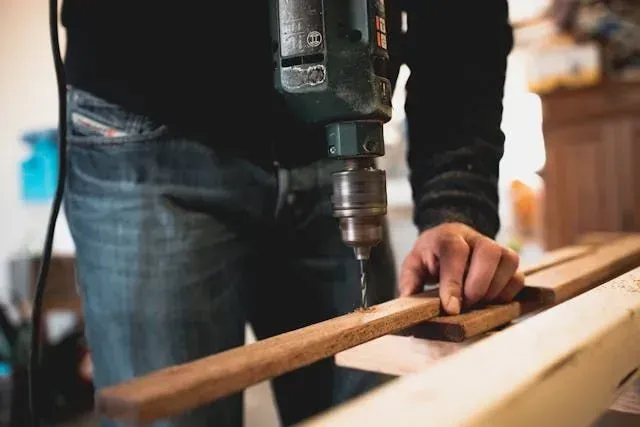
A cordless drill is the single most useful tool in any homeowner's toolkit, and knowing how to use one properly covers a surprising range of carpentry tasks. This includes drilling pilot holes before driving screws to prevent wood from splitting, understanding the difference between drill bits and driver bits, selecting the right screw length and gauge for the material and application, and knowing when to use wall anchors versus driving directly into a stud.
Understanding fixings also means knowing which screws are appropriate for which jobs — wood screws, drywall screws, decking screws, and multi-purpose screws all behave differently and are designed for specific applications. Using the wrong fixing in the wrong material is one of the most common causes of shelves, fixtures, and fittings failing over time.
4. Hammering and Nailing
Despite the rise of nail guns and power tools, knowing how to use a hammer correctly is still a genuinely useful skill. This means choosing the right hammer weight for the task — a lighter 16oz hammer for general work, a heavier framing hammer for structural tasks — holding the handle near the end rather than the head for maximum control, and driving nails at a slight angle when joining boards for a stronger hold. A nail punch is used to drive nail heads just below the surface so they can be filled cleanly — important when finishing trim or skirting boards.
5. Basic Joinery — How Wood Comes Together
Understanding how pieces of wood are joined together gives you insight into how furniture, cabinets, and structural elements in your home are built — and how to repair them when they fail. The most common joints a homeowner encounters are butt joints, where two pieces meet end to face; lap joints, where pieces overlap; and mortise and tenon joints, which are common in older furniture and door frames. For most basic repairs and projects, butt joints reinforced with screws or pocket hole joinery are entirely sufficient and much more beginner-friendly than complex traditional joinery.
6. Wood Preparation — Sanding and Finishing
Raw wood needs preparation before any paint, stain, or varnish is applied. Sanding removes rough surfaces, tool marks, and old finish, and is done in sequence from coarser to finer grit — typically starting around 80 or 100 grit and finishing at 180 to 220 grit for a smooth surface. Always sand in the direction of the wood grain to avoid visible scratches in the finished surface. After sanding, wood dust must be fully removed before any finish is applied — a tack cloth or vacuum works well for this.
Choosing the right finish — paint, stain, oil, varnish, or lacquer — depends on where the wood is located, how much wear it will receive, and the aesthetic you're aiming for. Exterior wood needs weather-resistant finishes. Interior hardwood floors need durable, wear-resistant coatings. Decorative trim simply needs a clean paint finish that matches the room.
7. Fixing and Hanging — Shelves, Frames, and Cabinets
Knowing how to fix things securely to walls is one of the most practically useful carpentry skills for homeowners. This means being able to locate wall studs using a stud finder or the knock test, understanding the difference between solid masonry walls and stud partition walls and how fixing methods differ between them, selecting the right wall plug and screw combination for the load being hung, and using a spirit level to ensure shelves and frames are perfectly horizontal or vertical before final fixing.
A shelf fixed into studs or solid masonry with the correct fixings will hold safely for decades. A shelf fixed with inadequate plugs into hollow plasterboard will eventually pull out — often taking a section of wall with it.
8. Basic Door and Window Adjustments
Doors that stick, won't latch, or swing open on their own are among the most common carpentry complaints in homes across Greenville and surrounding areas. Understanding why doors misbehave — seasonal wood movement, settlement, worn hinges, or incorrectly fitted strike plates — means you can often resolve minor issues yourself. Tightening loose hinge screws, adjusting a strike plate position by a few millimetres, or planing a small amount from a sticking edge are all beginner-accessible fixes when approached carefully.
9. Patching and Repairing Wood Damage
Wood filler, epoxy wood repair compound, and splice repairs are the three main approaches to fixing damaged timber. Wood filler is ideal for small holes, dents, and surface imperfections in painted timber — it sands and paints well but has limited structural strength. Epoxy wood repair compound is used for more significant rot damage, particularly on exterior timber like window sills and door frames, where it bonds firmly and can be shaped and painted once cured. For structurally compromised sections — a rotten deck board, a cracked joist, or a badly damaged door frame — a splice or full replacement of the damaged section is the correct approach.
10. Understanding Wood Types and When They Matter
Not all wood is the same, and using the right wood for the right application makes a significant difference to both the result and the longevity of any project. Softwoods like pine and spruce are widely available, easy to work, and appropriate for framing, shelving, and general carpentry. Hardwoods like oak, maple, and walnut are denser, more durable, and better suited to flooring, furniture, and feature elements. Sheet materials — plywood, MDF, and OSB — each have different properties that make them suited to specific applications. MDF paints beautifully and is ideal for interior trim and cabinet doors. Plywood is stronger and more moisture-resistant, making it better for structural and semi-exposed applications.
Essential Basic Carpentry Tools for Homeowners
- Tape measure — at least 5 metres, with a locking mechanism
- Carpenter's square and combination square — for marking accurate right angles
- Cordless drill and driver — the single most versatile tool you can own
- Handsaw — for smaller cuts where a power saw isn't practical
- Miter box — for clean, accurate angled cuts on trim and mouldings
- Spirit level — at least 600mm for shelves and frames
- Hammer and nail punch — for general nailing and finishing
- Chisels — a basic set of 3 or 4 sizes covers most repair work
- Clamps — essential for holding work securely while glue sets or cutting
- Sanding block and assorted grits — for surface preparation and finishing
- Stud finder — for safe and secure wall fixing
- Utility knife — for scoring, marking, and trimming
Our Carpentry Services in Greenville, SC
While the basics above cover a solid range of minor repairs and small projects, there are plenty of carpentry jobs where the skill, tools, and experience of a professional make a real difference to the quality and longevity of the result. Our carpentry service covers the full range of common residential carpentry needs for homeowners across Greenville, Taylors, Greer, Travelers Rest, Simpsonville, Mauldin, Fountain Inn, and Spartanburg.
Our rate is $125 per hour with no hidden fees. Materials are either supplied by you or sourced by us and billed at cost — no markup. Every job starts with a free, customised quote, and we stand behind all our work with a full satisfaction guarantee.
Our carpentry services include:
- Door repairs and adjustments — sticking doors, broken hinges, damaged frames, and new door hanging
- Cabinet repairs and refitting — hinges, doors, drawer runners, and cabinet fixing
- Custom shelving installation — alcove shelving, floating shelves, and built-in storage
- Trim and moulding work — skirting boards, architrave, cornice, and dado rail fitting
- Deck and fence repairs — board replacement, post repairs, and structural fixes
- Staircase repairs — squeaky treads, loose balusters, and handrail fixes
- Wood rot repairs — window sills, door frames, and exterior timber
- Furniture assembly and repair — flat pack assembly, joint repairs, and fixes
- General timber repairs — patching, splicing, and replacement of damaged sections
Whether it's a single sticking door in Taylors, a full set of alcove shelves in Greenville, or deck repairs in Spartanburg — we approach every job with the same attention to detail and commitment to a clean, lasting result.
When to Call a Professional Carpenter Rather Than DIY
- The job involves structural timber — joists, beams, load-bearing elements
- Precision is critical — fitted furniture, staircase work, or hardwood floor repairs
- The damage is more extensive than it first appeared — rot, pest damage, or water damage
- You don't have the right tools and purchasing them wouldn't make financial sense
- The job needs to meet building code requirements — decks, railings, and certain structural repairs
- Time is a factor — a professional will complete in hours what might take a weekend of DIY
Frequently Asked Questions
What is the most important basic carpentry skill to learn first?
Accurate measuring and marking is the foundation of everything else in carpentry. Before you learn to cut, join, or finish — learning to measure correctly and consistently will save you more time, material, and frustration than any other single skill. Once you can measure and mark accurately, every other skill builds on that foundation.
Can a handyman handle carpentry work or do I need a specialist carpenter?
For the vast majority of residential carpentry needs — door repairs, shelving, trim work, cabinet fixes, deck repairs, and general timber work — a skilled handyman is entirely appropriate and often more cost-effective than a specialist carpenter. Our carpentry service covers all of these areas across the Greenville, SC area at $125/hr with no hidden fees.
How do I fix a door that keeps sticking?
Sticking doors are usually caused by one of three things: seasonal wood expansion from humidity, loose or worn hinges allowing the door to drop, or the frame having shifted slightly over time. Start by checking the hinges — tighten all screws and replace any that are stripped. If the door still sticks, identify exactly where it's catching by sliding a piece of paper around the frame when closed. Light sticking can often be resolved by sanding or planing the contact point. If the frame has moved significantly, a handyman can assess and correct the alignment properly.
How do I stop a squeaky stair tread?
Squeaky treads are caused by movement between the tread and the riser or stringer below — usually because the original fixing has worked loose or the timber has dried and shrunk slightly over time. From above, driving screws at an angle through the tread into the riser below — and countersinking the heads so they can be filled — is an effective fix in most cases. If access from below is possible, screwing or gluing blocking between the riser and tread eliminates movement entirely. If the squeak persists or multiple treads are affected, a handyman can assess the staircase structure properly.
What wood is best for outdoor carpentry projects?
For exterior carpentry in the Greenville, SC climate — which brings humidity, heat, and seasonal rainfall — choosing moisture-resistant and rot-resistant timber is essential. Pressure-treated pine is the most widely used and cost-effective option for decking, fencing, and structural outdoor timber. Cedar and redwood are naturally rot-resistant and perform well for decking and cladding. Composite decking is a low-maintenance alternative that eliminates rot entirely. For any painted exterior trim work, moisture-resistant MDF or exterior-grade hardwood are both appropriate depending on the application and budget.
How long does it take to install custom shelving?
A single alcove shelf with a clean painted finish typically takes 2 to 4 hours depending on the wall type, the number of fixing points, and whether any finishing work is required. A full set of built-in alcove shelving across both sides of a chimney breast — including shelves and a storage cupboard below — typically takes a full day or more. We'll give you a clear time and cost estimate as part of your free quote before any work begins.
Do you supply wood and materials for carpentry jobs?
Yes — we can source all required timber and materials on your behalf and bill them at cost with no markup. If you already have specific materials or a preferred supplier, that works just as well. We'll always confirm exactly what's needed and the material cost before purchasing anything, so there are never any surprises on your final invoice.
Ready to Get Your Carpentry Jobs Done Right?
Whether you've got a list of small carpentry repairs that have been building up, a new shelving project you want done properly, or a more significant timber repair that needs professional attention — we're ready to help.
Call us today: (864) 209-1706 or get your free quote online. Honest pricing, flexible scheduling, materials sourced at cost — and every job backed by our full satisfaction guarantee.
Proudly serving: Greenville · Taylors · Greer · Travelers Rest · Simpsonville · Mauldin · Fountain Inn · Spartanburg